Coherence and noise
How a qubit loses information, and to what: T1/T2 decay, Ramsey dephasing against a wandering environment, a two-level-system defect drifting through resonance, and the noise-bias engineering (dynamical decoupling, a Kerr-cat’s protected subspace) built to outlast it.
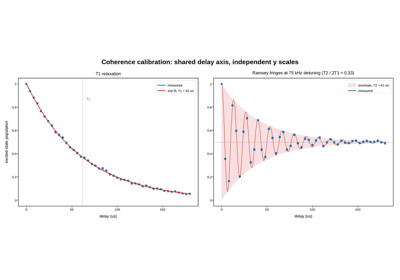
Qubit coherence: T1 relaxation and T2 Ramsey fringes
Qubit coherence: T1 relaxation and T2 Ramsey fringes
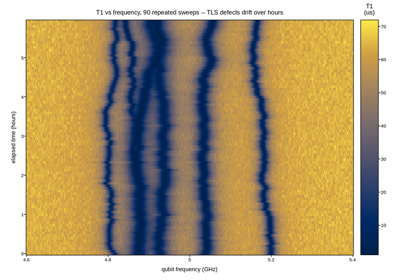
T1 relaxation vs frequency and time: wandering TLS defects
T1 relaxation vs frequency and time: wandering TLS defects
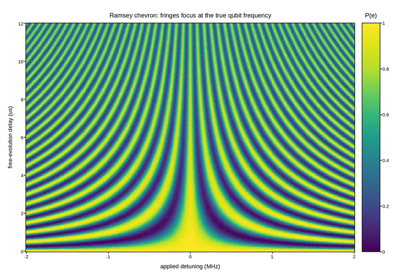
Ramsey chevron: frequency calibration from a fringe pattern
Ramsey chevron: frequency calibration from a fringe pattern
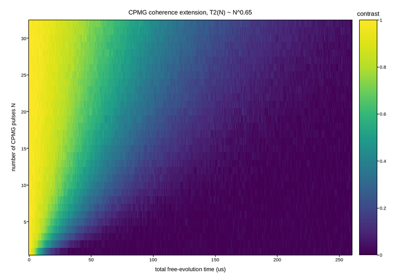
CPMG dynamical decoupling: coherence extension vs number of pulses
CPMG dynamical decoupling: coherence extension vs number of pulses
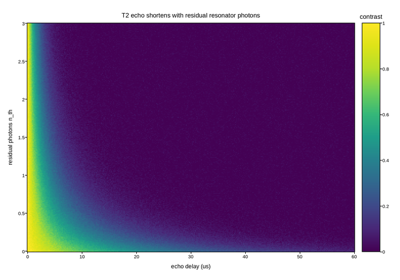
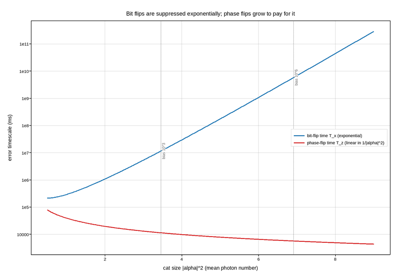
Kerr-cat qubit: exponential bit-flip protection, linear phase-flip cost
Kerr-cat qubit: exponential bit-flip protection, linear phase-flip cost