Note
Go to the end to download the full example code.
Error-amplification gate calibration: pulse-angle error vs repetitions
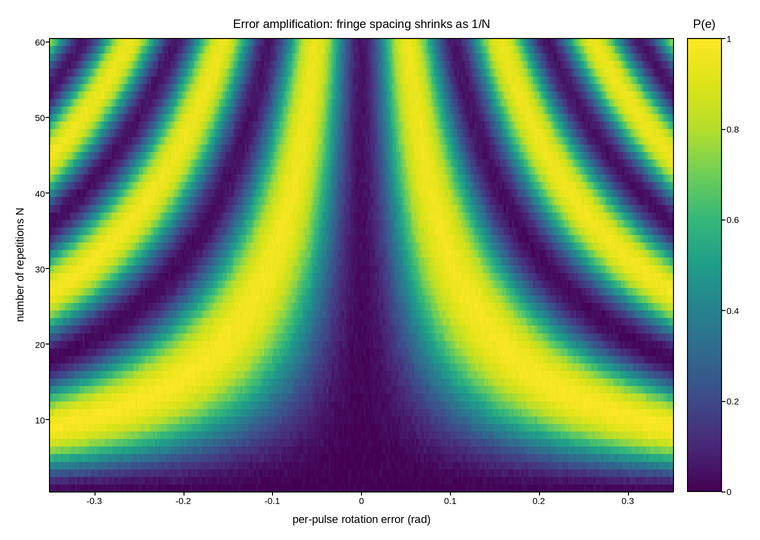
Excited-state population after applying N repeated pi pulses, each
carrying the same small deliberate rotation-angle error epsilon, swept
over both. A single imperfect pulse leaves an error too small to see above
readout noise; repeating it accumulates the error N-fold, so the population
oscillates as sin^2(N epsilon / 2) and the fringe spacing in epsilon
shrinks as 1/N – exactly the effect that makes this sequence, not a
single-shot measurement, the way amplitude errors are actually calibrated in
practice. Reading the map at any fixed large N and finding the nearest
fringe to epsilon = 0 gives the pulse-amplitude correction directly; a
single pulse could never resolve it this precisely.
Gate infidelity accumulates with repetition too, which is why the fringe contrast fades toward the top of the map rather than staying crisp forever – a real amplification sequence has a practical ceiling on how many repeats are worth applying before decoherence outruns the amplification.
Live figure — pick a tool, then zoom, pan, point-pick or annotate. Nothing is active until a tool is selected.
View this figure’s Vega export ↗ — the raw JSON spec, rendered live by a real Vega engine.
View this figure’s Vega-Lite export ↗ — the raw JSON spec(s), rendered live by a real Vega-Lite engine.
import numpy as np
import polars as pl
import plotpress

GATE_INFIDELITY = 0.0018     # per-gate depolarizing-like error
N_MAX = 60
rng = np.random.default_rng(2024)

angle_error = np.linspace(-0.35, 0.35, 320)     # radians, per-pulse rotation error
repetitions = np.arange(1, N_MAX + 1)
EPS, N = np.meshgrid(angle_error, repetitions)

contrast = (1.0 - GATE_INFIDELITY) ** N
p_excited = 0.5 - 0.5 * contrast * np.cos(N * EPS)
p_excited += rng.normal(0.0, 0.012, p_excited.shape)

# One row per swept (angle error, repetitions) shot -- sorted before the
# reshape below so the pivot back to a grid is correct regardless of order.
sweep = pl.DataFrame({
    "angle_error_rad": EPS.ravel(),
    "repetitions": N.ravel(),
    "p_excited": p_excited.ravel(),
}).sort(["repetitions", "angle_error_rad"])

angle_axis = sweep["angle_error_rad"].unique().sort().to_numpy()
repetitions_axis = sweep["repetitions"].unique().sort().to_numpy()
p_excited = sweep["p_excited"].to_numpy().reshape(repetitions_axis.size, angle_axis.size)

fig, ax = plotpress.subplots(figsize=(7.6, 5.4))
mesh = ax.pcolormesh(angle_axis, repetitions_axis, p_excited, cmap="viridis",
                     vmin=0.0, vmax=1.0)
bar = fig.colorbar(mesh, ax=ax)
bar.set_title("P(e)")
ax.set_xlabel("per-pulse rotation error (rad)")
ax.set_ylabel("number of repetitions N")
ax.set_title("Error amplification: fringe spacing shrinks as 1/N")
fig.tight_layout()
Total running time of the script: (0 minutes 0.201 seconds)