Note
Go to the end to download the full example code.
Morphogen gradient formation, animated
How a developing embryo turns one localized source of a signaling protein into a graded readout of position – the mechanism behind Bicoid in the early fly embryo. Protein is produced at one end, diffuses, and degrades everywhere with a fixed half-life; solving
dC/dt = D d^2C/dx^2 - k C
forward in time by explicit finite differences (the same scheme A pressure pulse bouncing down a rigid duct, animated uses for a wave rather than a diffusion) shows how the exponential profile is reached, not just what it looks like once it is.
The steady-state shape C(x) = C0 exp(-x / lambda) is a standard result,
but the animation is the point: early on the gradient is a diffusing front
that has not yet felt the far end of the domain, and it only settles into
the clean exponential once diffusion and degradation have had time to
balance, at lambda = sqrt(D / k). Reading a snapshot taken too early as
though it were the steady-state gradient is a real interpretive error in
this kind of data, and watching the profile visibly still relaxing makes it
concrete.
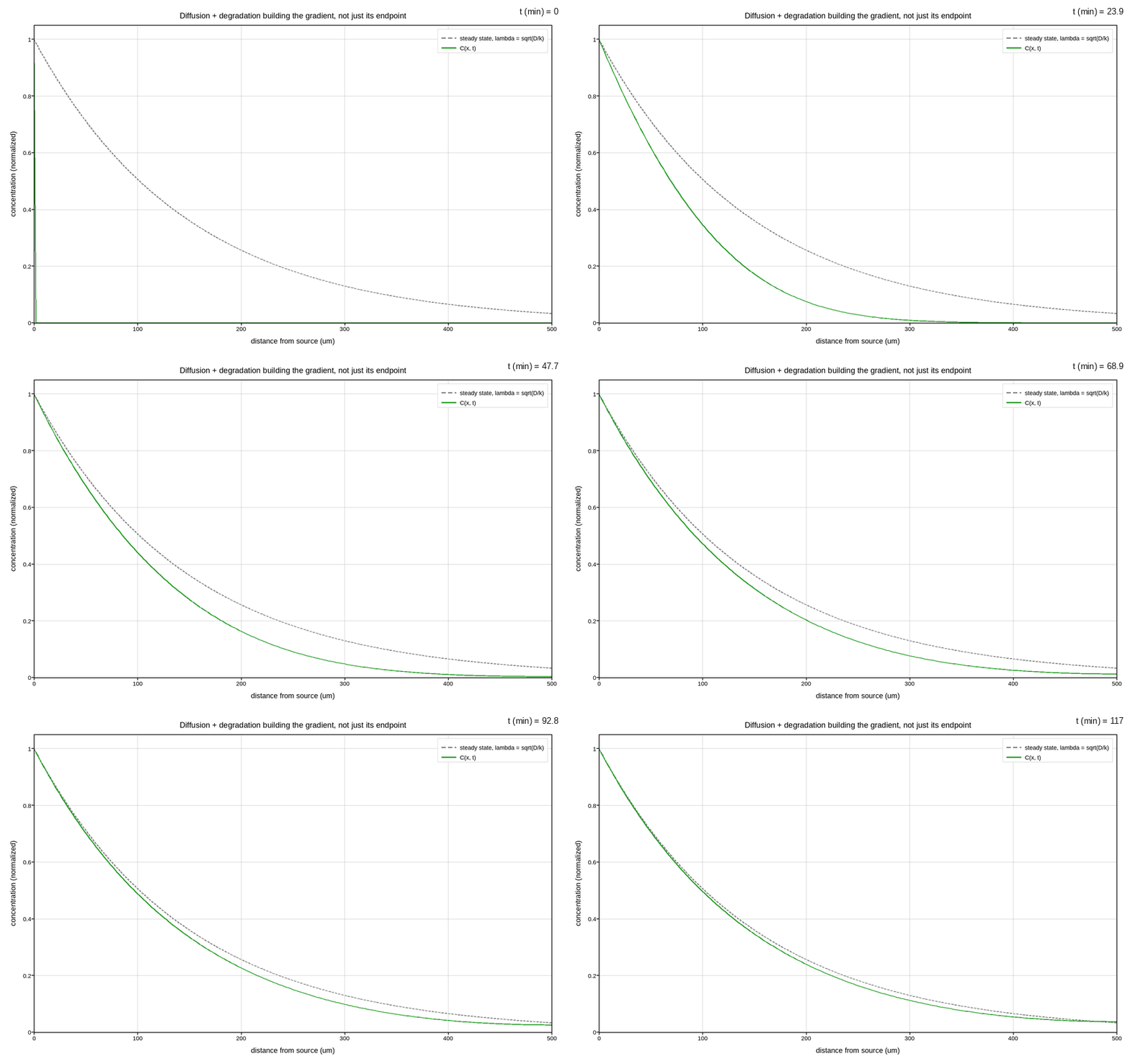
Live figure — pick a tool, then zoom, pan, point-pick or annotate. Nothing is active until a tool is selected.
View this figure’s Vega export ↗ — the raw JSON spec, rendered live by a real Vega engine.
View this figure’s Vega-Lite export ↗ — the raw JSON spec(s), rendered live by a real Vega-Lite engine.
import os
import tempfile

import numpy as np
import plotpress

D = 5.0                                             # diffusion coefficient (um^2/s)
K = 2.31e-4                                          # degradation rate (1/s), ~50 min half-life
C0 = 1.0                                             # source concentration at x=0
L = 500.0                                            # domain length (um)

N = 251
x = np.linspace(0.0, L, N)
dx = x[1] - x[0]
dt = 0.3                                             # < 0.5*dx^2/D, stable

conc = np.zeros(N)
conc[0] = C0

N_FRAMES = 45
STEPS_PER_FRAME = 530
frames = np.empty((N_FRAMES, N))
frames[0] = conc.copy()
r = D * dt / dx ** 2

for f in range(1, N_FRAMES):
    for _ in range(STEPS_PER_FRAME):
        lap = np.empty(N)
        lap[1:-1] = conc[2:] - 2 * conc[1:-1] + conc[:-2]
        lap[-1] = conc[-2] - conc[-1]                # zero-gradient far boundary
        conc = conc + dt * (D * lap / dx ** 2 - K * conc)
        conc[0] = C0                                 # fixed source at x=0
    frames[f] = conc.copy()

t_min = np.arange(N_FRAMES) * STEPS_PER_FRAME * dt / 60.0
steady = C0 * np.exp(-x / np.sqrt(D / K))

fig, ax = plotpress.subplots(figsize=(8.6, 5.4))
ax.plot(x, steady, color="#888888", linestyle="--", linewidth=1.4,
        label="steady state, lambda = sqrt(D/k)")
ax.plot_frames(x, frames, slider_values=t_min, slider_label="t (min)",
              color="#2ca02c", label="C(x, t)")
ax.set_ylim(0.0, C0 * 1.05)
ax.set_xlim(0.0, L)
ax.set_xlabel("distance from source (um)")
ax.set_ylabel("concentration (normalized)")
ax.set_title("Diffusion + degradation building the gradient, not just its endpoint")
ax.legend(loc="upper right")
ax.grid(True)
fig.tight_layout()

gif_path = os.path.join(tempfile.gettempdir(), "plotpress_morphogen_gradient.gif")
fig.save(gif_path, fps=15)
Total running time of the script: (0 minutes 8.553 seconds)