Note
Go to the end to download the full example code.
Text is single-line, and PNG is a separate renderer
Two design choices meet here. plotpress lays out only single-line strings – there is no rich text, no math, no multi-line wrapping. And PNG is drawn by a second backend (Pillow) rather than by rasterizing the SVG, because every SVG rasterizer in Python needs cairo, a system library rather than a pip wheel.
A newline exposes both at once. The raster backend breaks the line; an SVG
viewer collapses the \n to a space. So the same figure with a \n in a
label looks different depending on the format – the one place the two backends
visibly disagree.
The figure below is a PNG, so the red label breaks into two lines. In SVG it
would read peak 3.2 (2024) on a single line. The green label uses two
separate text() calls and looks identical in every format.
import numpy as np
import plotpress

x = np.linspace(0, 10, 200)
y = np.sin(x) * np.exp(-x / 8)

fig, ax = plotpress.subplots(figsize=(8, 4.5))
ax.plot(x, y)

# Not portable: one text() call with a newline. PNG (this image) breaks it into
# two lines; an SVG viewer collapses the newline and draws it on one line.
ax.text(5.6, 0.6, "peak 3.2\n(2024)", color="#d62728", fontsize=12, va="top")

# Portable: two text() calls, one per line. Identical in PNG, SVG and PDF.
ax.text(5.6, 0.0, "peak 3.2", color="#2ca02c", fontsize=12)
ax.text(5.6, -0.1, "(2024)", color="#2ca02c", fontsize=12)

ax.set_title("A newline renders in PNG but collapses in SVG")
ax.set_xlabel("x")
ax.set_ylabel("y")
fig.tight_layout()
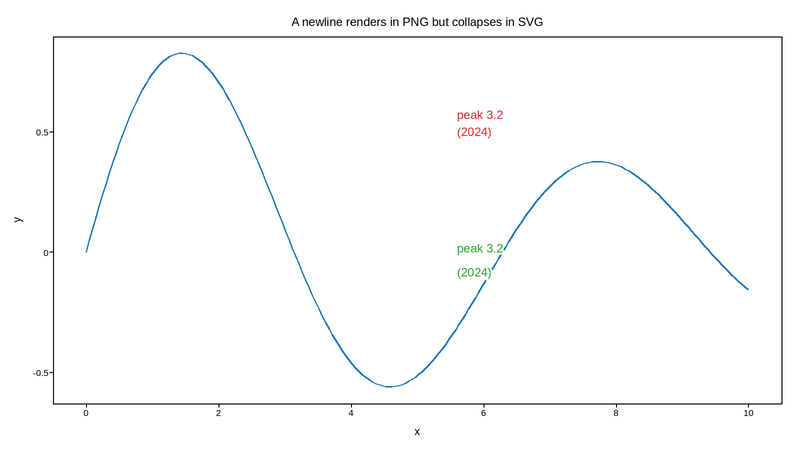
Live figure — pick a tool, then zoom, pan, point-pick or annotate. Nothing is active until a tool is selected.
View this figure’s Vega export ↗ — the raw JSON spec, rendered live by a real Vega engine.
View this figure’s Vega-Lite export ↗ — the raw JSON spec(s), rendered live by a real Vega-Lite engine.
Reading it
Red –
ax.text(..., "peak 3.2\\n(2024)"). Two lines here, one line in SVG. Never rely on a\\nif the same figure might be exported to more than one format.Green – two
text()calls at stackedypositions. Portable, and the only supported way to stack lines.
The broader point: SVG (and the PDF built from it) is the reference rendering, and PNG re-draws the same primitives through Pillow. They share the layout and the metrics, so they match closely, but they are not guaranteed pixel-identical – a newline is simply the case where the gap is obvious rather than sub-pixel.
Total running time of the script: (0 minutes 0.071 seconds)