Note
Go to the end to download the full example code.
Both axes growing: a search window expanding outward
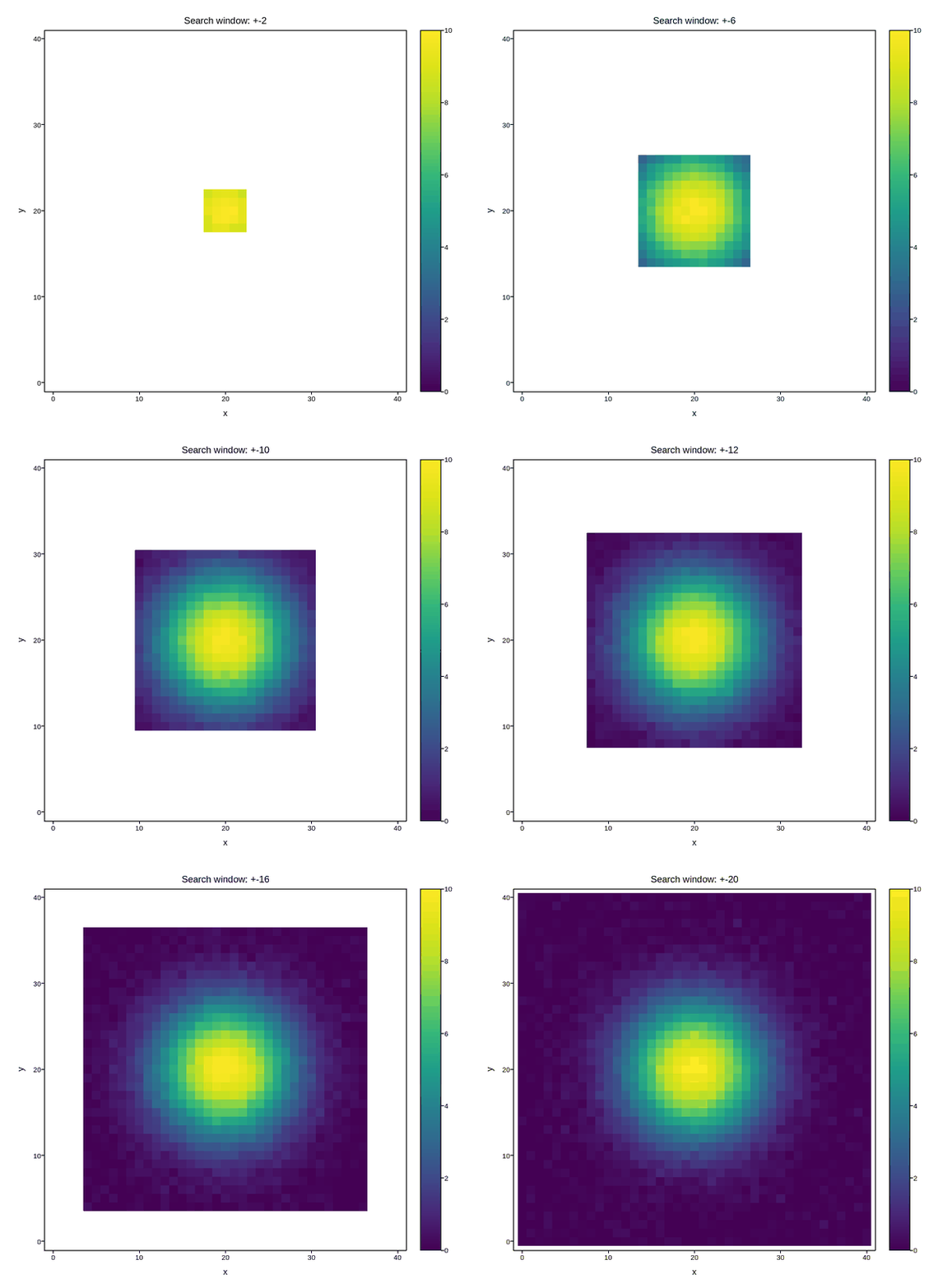
Combine An x axis whose extent isn’t known up front with the same growth in y: a search
that starts small and widens its window in both directions each time the
edge of what’s been measured still looks interesting – outward from a seed
region rather than sweeping the same fixed range. Both axes limits and
the mesh shape change every frame.
The code below is exactly what you’d write against the real
plotpress.qt.LiveArtist: a callback that receives a freshly re-measured
(and now larger) window and pushes it to the plot, fed by a loop simulating
a search controller that keeps widening until it decides it’s seen enough.
Only read_window() is meant to be replaced, with your own instrument
call.
import numpy as np
import plotpress


VMIN, VMAX = 0.0, 10.0   # the instrument's own known reading range
CX, CY = 20.0, 20.0      # the window's fixed center; only its extent grows
MAX_HALF = 20            # widest the window is ever allowed to grow

fig, ax = plotpress.subplots(figsize=(6, 5.5))
mesh = LiveArtist(ax, cmap="viridis", vmin=VMIN, vmax=VMAX)

# One-time colorbar: the scale is fixed, so it never needs a per-frame
# refresh the way plot_02_systematic_fill's autoscaled one does.
m0 = ax.pcolormesh(np.array([CX - 1, CX + 1]), np.array([CY - 1, CY + 1]),
                   np.zeros((1, 1)), cmap="viridis", vmin=VMIN, vmax=VMAX)
fig.colorbar(m0, ax=ax)


def on_new_scan(half, gx, gy, C):
    """Called each time the search widens its window and re-measures it."""
    mesh.update(gx, gy, C)
    ax.set_aspect("equal")             # cla() inside update() wiped these
    ax.set_xlim(CX - MAX_HALF - 1, CX + MAX_HALF + 1)   # fixed frame
    ax.set_ylim(CY - MAX_HALF - 1, CY + MAX_HALF + 1)
    ax.set_xlabel("x"); ax.set_ylabel("y")
    ax.set_title(f"Search window: +-{half}")
    fig.tight_layout()


# ---------------------------------------------------------------------------
# Data acquisition -- replace this with your own search controller. Every-
# thing above only needs a re-measured (gx, gy, C) window handed to
# on_new_scan() each time it widens.
# ---------------------------------------------------------------------------
rng = np.random.default_rng(23)


def read_window(half):
    """Stand-in for the instrument re-scanning a window of half-width
    ``half`` centered on (CX, CY).
    """
    n = 2 * half + 1
    gx = np.linspace(CX - half, CX + half, n)
    gy = np.linspace(CY - half, CY + half, n)
    xs, ys = np.meshgrid(gx, gy)
    C = (np.exp(-((xs - CX) ** 2 + (ys - CY) ** 2) / 60.0) * 10.0
         + 0.15 * rng.standard_normal(xs.shape))
    return gx, gy, C


for half in range(2, MAX_HALF + 1, 2):
    gx, gy, C = read_window(half)
    on_new_scan(half, gx, gy, C)
Total running time of the script: (0 minutes 1.169 seconds)